Sir Simon’s chained and starved remains
The Canterville GhostSir Simon’s chained and starved remains are the concealed physical evidence of the cruelty behind the haunting at Canterville Chase. Found in a hidden room after Virginia leads her family there, the skeleton discloses the tragedy of his death: he was chained to an iron ring and left to starve, with a trencher of dust and a mould-covered water jug just beyond his grasp. Virginia kneels beside him to pray, turning the discovery from a revelation of past violence into an act of compassion.
Discovery in the Hidden Room
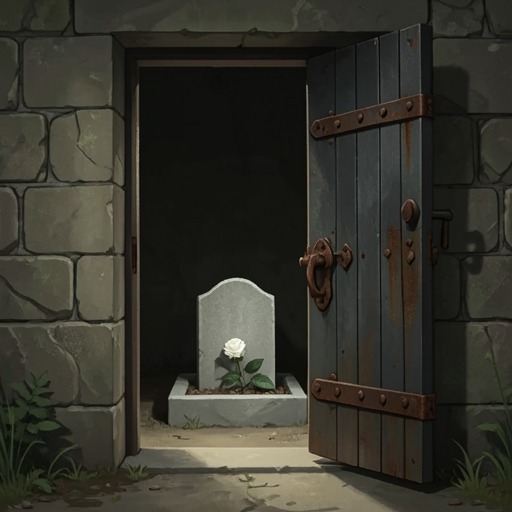
After Virginia tells her family that the Ghost is dead and asks them to come and see him, she leads them through an opening in the wainscoting and down a narrow secret corridor. Washington follows with a lighted candle. At the corridor’s end, they reach a great oak door studded with rusty nails; when Virginia touches it, the heavy door swings open onto a low room with a vaulted ceiling and a single tiny, grated window.
The room’s furnishings make the skeleton’s imprisonment legible. A huge iron ring is embedded in the wall, and a gaunt skeleton is chained to it, stretched out on the stone floor. Its long, fleshless fingers seem to reach for an old-fashioned trencher and ewer placed just beyond reach. The jug bears green mould inside, evidence that it once held water; the trencher holds only dust. These details show not merely confinement, but deprivation prolonged until food and water could no longer save the prisoner.
What the Remains Reveal
The hidden remains disclose the terrible history that the haunting had kept out of view. The iron ring and chain make the confinement concrete, while the unreachable vessels show how the room’s arrangement turned hunger and thirst into instruments of suffering. The skeleton’s outstretched hands preserve the last visible gesture of a body reaching for what it was denied.
The discovery also changes the meaning of the Ghost’s story. The family’s wonder gives way to the recognition of a tragedy whose secret is now exposed. What had been encountered as a haunting is revealed to have a human history of cruelty and abandonment; the remains are the evidence that makes that history visible.
Virginia’s Response and Significance
Virginia kneels beside the skeleton, folds her hands, and prays silently while the others look on. Her response stands apart from the family’s astonishment: she attends to the dead prisoner not as a frightening spectacle but as someone whose suffering calls for compassion. The physical discovery thus becomes the setting for her intervention, joining the revelation of the past to an act directed toward the Ghost’s release.
The scene’s force comes from the contrast between the small, sealed chamber and the scale of the violence it contains. Its low ceiling, barred window, heavy door, chain, and out-of-reach vessels make the room a record of entrapment. Yet the remains do not only conclude a mystery: beside them, Virginia’s prayer marks a change from concealed suffering toward mercy.